
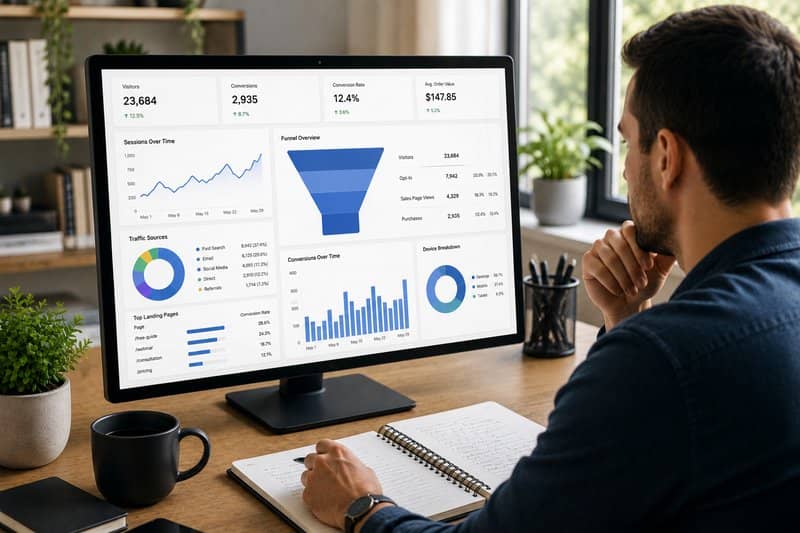
When your funnel underperforms, your first instinct might be to change the design, rewrite the offer, or swap out a headline. And while that may sometimes work, more often than not, those choices become guesswork when you do not have the data to support them. To get stronger results, start by understanding how people move through your funnel, where they hesitate, and what pushes them to convert.
That is where data and analytics become valuable. They show you how your audience behaves rather than leaving you to assume what they want. Many businesses also rely on lead funnel software to track user behavior and organize this data in one place. When you use that information to optimize a landing page for lead generation, you can make better decisions and increase conversions with more confidence. You do not need a huge team or a complicated system to do this well. You need a clear process, a few meaningful metrics, and the discipline to keep refining what you build.
Track the Right Funnel Metrics
If you try to measure everything, you will end up distracted by numbers that look interesting but do not help you improve performance. A stronger approach is to focus on the metrics that reveal how well your funnel moves people from one stage to the next. You want to know where people enter, stay engaged, and leave.
For example, if you drive traffic from email, social media, or ads, compare the quality of those sources. You may find that one source sends a lot of visitors but very few conversions, while another sends fewer visitors who convert at a much higher rate. That kind of insight helps you spend your time and budget more wisely. A funnel is only as strong as the path people take through it, so each stage deserves attention.
You should also look at page-level behavior. Consider variables such as how long people stay on the page, whether they click the call to action, or abandon the form halfway through. These details matter because they show whether your message is clear and whether your offer matches what your audience expected.
If you’re using Google Analytics, you can look at bounce rates, average time on page, key actions taken, and set up tracking for video clicks, button clicks, and segment actions by position on the page so you know how far people are reading. All of these stats can give you a bird’s-eye view of how visitors from particular channels perform, while also showing how far down the funnel people reach.
Use Data to Improve Lead Generation
Your landing page often sets the tone for the rest of the funnel. If it feels confusing, cluttered, or disconnected from the traffic source, people leave before they ever become leads. That is why it helps to review landing page data with a practical mindset. You are not trying to admire the page. You are trying to understand whether it works.
Start with your conversion rate, but do not stop there. A low conversion rate indicates a problem, though it does not tell you the cause. To find that answer, you need to look deeper. Review scroll depth, button clicks, bounce rate, and form completion behavior. If visitors do not scroll far enough to see your offer, your page may need a clearer headline or tighter layout. If they click but do not submit, your form may be too long or too demanding.
Picture a small coaching business offering a free strategy guide. If the page asks for a name, email, phone number, company name, and budget range, many visitors will leave before finishing. If that same page only asks for a first name and an email address, completions may rise quickly. When you optimize a landing page for lead generation, small changes often have a measurable impact by reducing friction in the experience.
Lastly, don’t forget that numbers are relative to your industry and offer. A low-risk offer such as a free download top of funnel may have wildly different conversion rates than a high-ticket sale to join a private mastermind at the very end of your offer stack.
Spot Funnel Drop-Offs Before They Hurt Your Results
A funnel can look solid from the outside and still lose leads at key points. You may have a strong opt-in page and a solid offer, yet your results stay flat because people disappear between stages. That is why you need to identify drop-off points early. When you know where momentum slows down, you can adjust the messaging, timing, or structure before weak performance becomes a pattern.
Email follow-up is a common place where this happens. You might collect leads effectively, then lose them because the next message feels generic or arrives too late. If your analytics show that people opt in but rarely open the next email, your subject line may need work. If they open the email but never click, the content may not match the promise that brought them into the funnel in the first place.
The same logic applies to sales pages, booking pages, and checkout steps. If people reach the final stage and leave, the issue may be uncertainty rather than a lack of interest. They may need more proof, a clearer explanation, or a simpler next step. Data helps you diagnose that instead of guessing your way through revisions.
Use A/B Testing to Improve with Purpose
Once you have enough data to see a pattern, you can begin testing changes with more intention. A/B testing works best when you isolate one meaningful variable at a time. That might be your headline, your call to action, your image choice, or the number of fields in your form. The point is to learn what helps your audience move forward.
Let’s say your current landing page gets traffic but converts poorly. Instead of redesigning the entire page, test a headline that speaks more directly to the visitor’s goal. If you offer funnel support for small businesses, a vague headline about growth may underperform compared to one that clearly explains the benefit. You want people to understand the value within seconds. Clear messaging usually performs better than clever wording because it reduces uncertainty.
You can also test format changes. A short page may outperform a long one for a simple lead magnet. A longer page may work better when your audience needs more education before taking action. Testing lets you compare those possibilities in a controlled way. Over time, you build a funnel based on evidence instead of instinct alone.
Start simply and build on what works. If you change too much, too fast, you won’t understand which variable(s) had the most impact.
Turn Analytics Into Ongoing Funnel Decisions
Data becomes useful when you apply it consistently. One review of your analytics can help, though the real advantage comes from building a habit of checking performance, learning from it, and refining your funnel over time. That process does not need to be complicated. It needs to be regular.
A simple routine might include reviewing traffic sources each week, checking landing page conversions, and watching for unusual changes in email engagement. If something drops suddenly, you can investigate before it affects the entire funnel. If something improves, you can study what changed and build on it. This keeps your funnel active and responsive instead of static.
You should also connect your findings back to audience intent. If one offer performs better than another, ask why. If one page holds attention longer, study what makes it easier to understand. Strong analytics work means interpreting behavior and using what you learn to create a smoother path for the people you want to serve.
Build a Funnel That Gets Smarter Over Time
You do not need a perfect funnel on day one. You need a funnel that can improve. Data and analytics give you that advantage by turning each visit, click, and conversion into something useful. They show you where to simplify and where to focus your effort.
Start by measuring what matters. Look closely at your landing pages, track where leads drop off, and test changes with intention. When you optimize a landing page for lead generation and support it with smart analytics, your funnel becomes easier to manage and more effective over time.
A strong funnel is built through steady improvement. When you use data well, you stop reacting blindly and start making informed decisions that move your business forward. Best of all, you can track all of this easily through funnel software like ClickFunnels or Go High Level. Both platforms help users connect analytics and make it easy to A/B test copy and funnel elements so you can continue to build a funnel that keeps converting.